

![]()
Advanced LLM Usage for CEOs and Executives Series
This short article series is designed to help owners, entrepreneurs, and senior staff use AI LLMs far better. As a past CTO and VP of Engineering who now uses AI every day, I have found that most executives understand neither its limitations nor its most powerful capabilities. These eight articles explain practical advantages as well as the traps—especially confident, credible-sounding answers that are wrong.
The 12-Minute Test That Tells You Whether Your Company Is Ready for AI
Article 8 of 8
Do not start by choosing an AI tool
Many CEOs begin with, “Which AI should we buy?” That is backwards. A subscription is not a business case. A clever prompt is not a business result. Even an impressive demonstration proves very little about whether employees will use the new method or whether it will improve profit, capacity, quality, or customer value.
Start with this question instead: Which workflow can produce the most measurable value with the least implementation risk? That forces management to compare opportunities instead of chasing the newest model.
Rank the opportunity and the execution risk separately
A good AI opportunity has two characteristics. First, the work matters: it is expensive, frequent, slow, error-prone, or close to revenue and customers. Second, the company can implement the change safely: reliable information exists, a manager owns the result, people can review the output, and employees can learn the new process.
Score each factor from 0 to 2: 0 = no, 1 = partly, 2 = clearly yes. Use evidence, not enthusiasm. Complete one scorecard for every proposed AI use case, then rank the totals.
The 12-Minute AI Opportunity Scorecard
| AREA | FACTOR | THE QUESTION TO ANSWER | 0–2 |
|---|---|---|---|
| VALUE | 1. Strategic value | Does this workflow support a real priority involving revenue, margin, customers, capacity, quality, or decision speed? | ___ |
| VALUE | 2. Pain and frequency | Is the work frequent, slow, expensive, repetitive, error-prone, or dependent on scarce expertise? | ___ |
| VALUE | 3. Measurable baseline | Do we know the current time, cost, conversion, throughput, quality, or error rate? | ___ |
| VALUE | 4. Near-term result | Can a small pilot produce a measurable result within 30–60 days? | ___ |
| EXECUTION | 5. Reliable context | Can AI access current, approved information, with a clear source of truth when files conflict? | ___ |
| EXECUTION | 6. Accountable owner | Is one manager accountable for the business result and authorized to change the workflow? | ___ |
| EXECUTION | 7. Human review and risk | Are mistakes detectable and reversible, with a named person responsible for review and approval? | ___ |
| EXECUTION | 8. People and adoption | Will users receive role-specific practice, support, manager reinforcement, and a way to report exceptions? | ___ |
| TOTAL OPPORTUNITY SCORE | ___ / 16 | ||
Interpret the score
Do not use one total to hide a fatal weakness. A high-value opportunity with no reliable data, no owner, or no human review is still a bad first implementation.
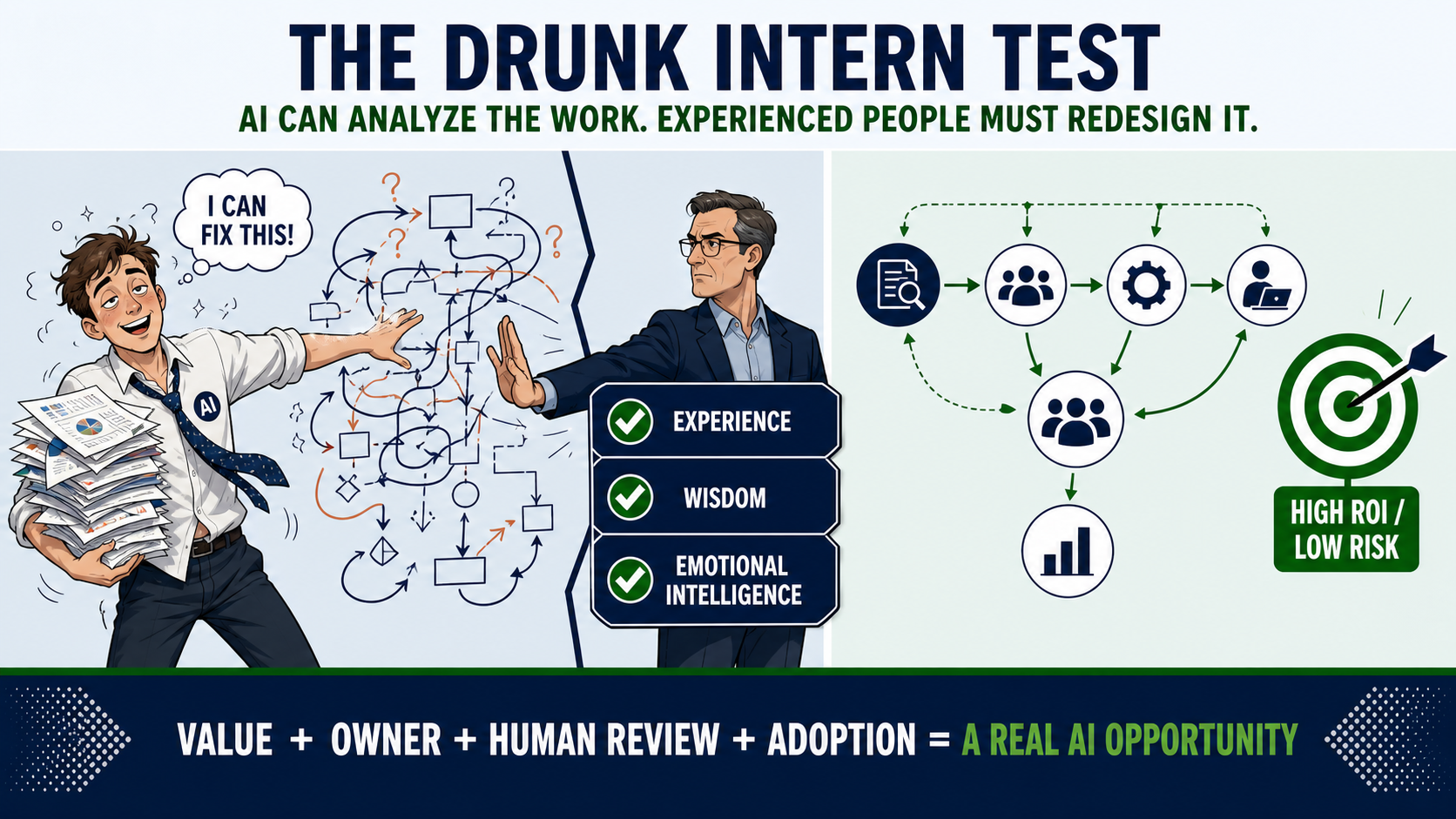
AI can analyze a workflow and suggest options. It should not redesign how people work without experienced human ownership.

For a free business assessment Zoom call on what is holding your company back that you may not see, click here. Bob Norton does all these personally. This offer is for CEOs and owners of companies with at least $500K in revenue or six or more employees. A complete written report is available to anyone for $1,200.
Start with one expensive, measurable bottleneck
Do not launch broad experimentation across the company and hope the best use cases identify themselves. List the workflows that consume time, delay revenue, create rework, frustrate customers, or depend on one overloaded expert. Score each one. Start with the highest-value opportunity that also has reliable data, a responsible owner, human review, and manageable consequences if the AI is wrong.
Good early candidates might include drafting a weekly customer report from approved CRM data, routing service requests before a person responds, comparing a contract against an approved checklist, or preparing a first draft of a proposal that a sales manager must approve. The result is measurable and mistakes can be caught before they create damage.
Do not begin with autonomous hiring or firing decisions, unsupervised legal commitments, automatic pricing changes, or emotionally sensitive customer decisions. High consequences and weak review make those poor first projects even when the technology looks impressive.
Apply the drunk intern rule
I often describe AI as a brilliant, occasionally drunk intern. It may read more than anyone in the company, produce an answer in seconds, and sound completely confident. It still lacks the lived experience, wisdom, emotional intelligence, and accountability required to redesign how people actually work.
Use AI to map the current process, identify delays, compare alternatives, find missing information, and draft a better workflow. Then involve the employees who perform the work, the manager who owns the result, and the people affected by the change. A technically elegant process that employees cannot trust or use is not an improvement.
ADVANCED MOVE – COPY/PASTE PROMPT Interview me one question at a time to identify and rank our best AI opportunities. For each proposed workflow, ask for the business pain, frequency, current time or cost, measurable baseline, expected value, authoritative data, accountable owner, human review, possible harm if the AI is wrong, employee adoption requirements, and the smallest result we could verify within 30–60 days. Score each factor from 0 to 2, challenge vague answers, rank the opportunities from highest value and lowest risk to lowest value and highest risk, and recommend the smallest safe pilot. Do not recommend a tool until the business case and operating conditions are clear. |
ROI must survive implementation
A spreadsheet may show attractive savings, but ROI does not exist until people use the new workflow correctly. Design the process with them. Train everyone in the same language and standards. Give managers a way to reinforce the behavior. Capture exceptions and corrections so the system improves.
The first AI decision is not which product to buy. It is where AI can create measurable value now, where the risk is acceptable, and what management must change before the company can capture the return.
ADVANCED LLM WEBINAR
COMING SOON
Most owners never get beyond prompts, drafts, and occasional research. This fall, AirTight Management will host an Advanced LLMs for CEOs live series built around real business work: better decisions, faster research, smarter workflows, stronger management systems, and more than 100 practical moves you can use—with some tools and models available nowhere else.
The launch price is $29 for the complete live, four-webinar series, recordings, and downloadable tools. Click here to register.
Explore the complete AI for CEOs article series:
- The Most Dangerous AI Answer Is the One That Sounds Right
- AI Can Write Your Strategy. That Is the Problem.
- AI Knows More Than You. It Still Has No Scars.
- Your AI Can Hold a Library and Still Miss the Facts That Matter
- The Week of Work Hiding Inside a Two-Minute Prompt
- Your AI Pilot Will Probably Die in the Handoff
- The Rejected AI Draft May Be More Valuable Than the Accepted One
- The 12-Minute Test That Tells You Whether Your Company Is Ready for AI
Use these articles as an operating guide: make AI show its assumptions, protect the strategy, provide reliable context, redesign the workflow, manage adoption, capture human corrections, and select opportunities where value is measurable and risk is controlled.

