

Advanced LLM Usage For CEOs and Executives Series
This short article series is designed to help owners, entrepreneurs, and senior staff use AI LLMs far better. As a past CTO and VP of Engineering and someone who has used AI every day in many ways for several years now, I have found most do not understand its limitations or its most powerful features either. These eight articles will reveal not just tips and tricks but major traps of using AI where it is confidently giving you bad answers that seem credible.
AI Can Confidently Produce Seriously Bad Recommendations
Article 1 of 8
Large language models can produce polished, confident answers even when their assumptions are wrong. This eight-part series shows CEOs, owners, and senior leaders how to use AI for faster research and better decisions—without confusing fluency with judgment. An LLM generates a plausible response from patterns, instructions, and the context it can see. It does not automatically verify every premise. If your prompt quietly assumes that price is the sales problem, that a new market behaves like the old one, or that the team has capacity, the model may build an elegant answer on a weak foundation.
Every LLM lacks human judgment and most of your company-specific context. It can therefore recommend strategies that are impractical—or impossible—to execute, while missing the human factors that determine whether the plan will work.
Getting AI to Be Radically Honest
Before I trust an important AI recommendation, I want to turn off all sycophantic behavior. Then I want the system to slow down and show me its work product in a form I can inspect. Not a private chain of thought—a management-ready ledger of evidence, assumptions, uncertainty, and consequences. You can turn off the AI trying to “please you” and get only fact-driven answers.
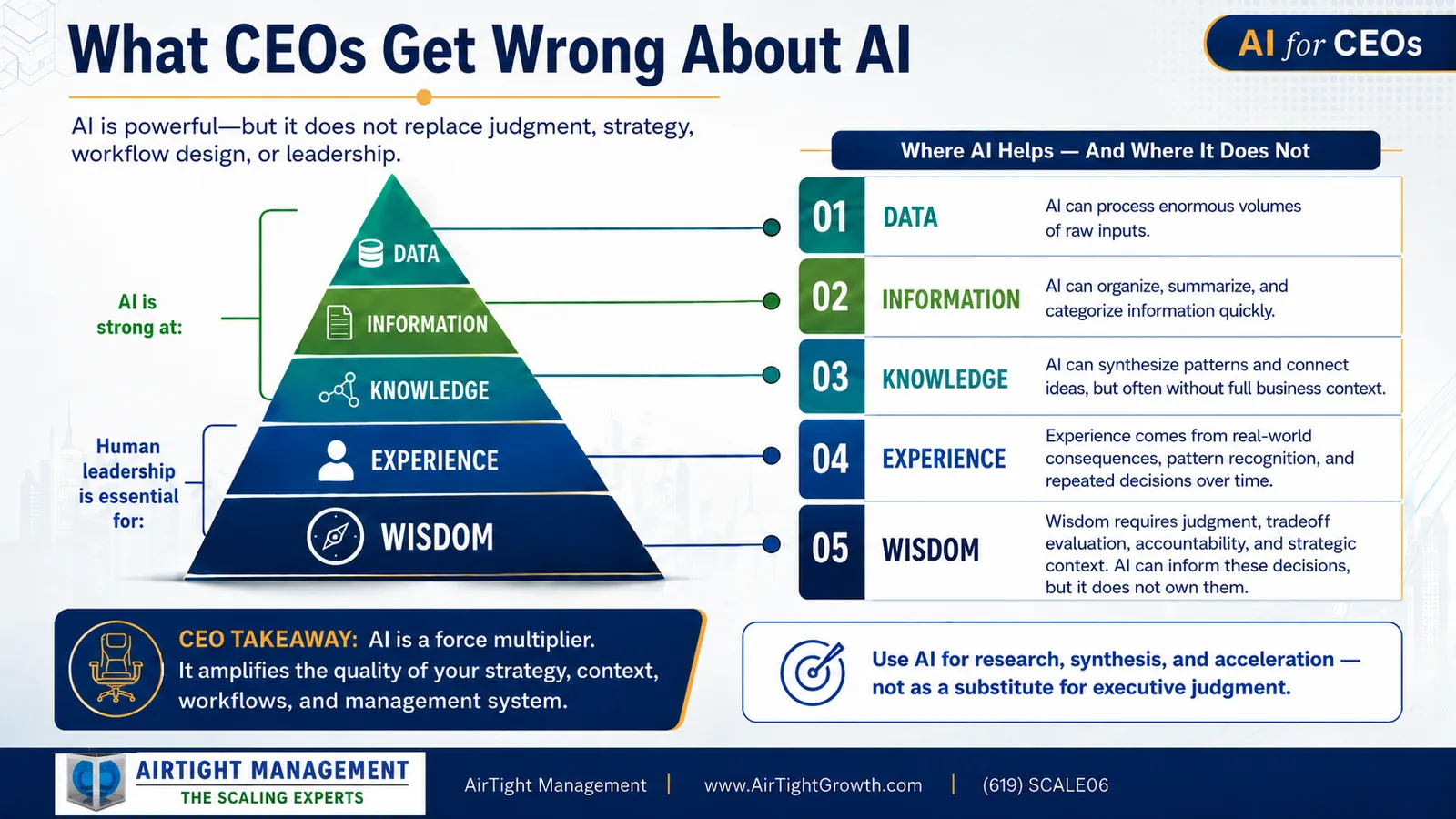
One key is knowing which questions AI cannot answer reliably. The diagram below shows where executive judgment must take over.
ADVANCED MOVE – COPY/PASTE PROMPTBefore recommending an action, create a Decision Assumption Ledger with six sections: 1) verified facts and their sources; 2) assumptions you are making; 3) important information that is missing; 4) confidence level for each major conclusion; 5) what evidence would change the recommendation; and 6) which parts require executive judgment rather than analysis. Then provide the recommendation. |
This does not eliminate hallucinations, although they are becoming less common. More importantly, it makes the answer auditable. You can see where the model relies on evidence, where it is guessing, and where your own judgment must take over.
Four ways companies make AI worse
- They confuse knowledge synthesis with wisdom and accountability.
- They ask generic questions without loading company-specific context.
- They give people tools without changing workflows, review standards, or ownership.
- They fail to capture corrections, successful prompts, and operating lessons for reuse.
The result is predictable: more content, more activity, and more noise. AI slop is not a model problem alone. It is what happens when an organization scales output without scaling judgment.

For a free business assessment Zoom call on what is holding your company back that you may not see, click here. Bob Norton does all these personally. Offer good for CEOs and owners at companies with at least $500K in revenue or 6+ employees. A complete written report is available to anyone for $1,200 here.
Use AI as a force multiplier, not an oracle
AI is already one of the best research, comparison, drafting, and pattern-finding tools ever placed on an executive’s desk. I keep several systems working throughout the day. But I treat them like brilliant, occasionally drunk assistants: fast, tireless, and never allowed to make the final high-consequence decision alone.
Strong companies will use AI to improve the quality and speed of human judgment. Weak companies will use it to manufacture certainty. The difference begins with whether the CEO asks for a polished answer – or an answer that can survive inspection.
ADVANCED LLM WEBINAR
COMING SOON
Most owners never get beyond prompts, drafts, and occasional research. This fall, AirTight Management will host an Advanced LLMs for CEOs live series built around real business work: better decisions, faster research, smarter workflows, stronger management systems, and more than 100 practical moves you can use with some tools and models available nowhere else.
The launch price is $29 for the complete live, four-webinar series, recordings, and downloadable tools.
Click here to register.