

Advanced LLM Usage for CEOs and Executives Series
This short article series is designed to help owners, entrepreneurs, and senior staff use AI LLMs far better. As a past CTO and VP of Engineering who now uses AI every day, I have found that most executives understand neither its limitations nor its most powerful capabilities. These eight articles explain practical advantages as well as the traps—especially confident, credible-sounding answers that are wrong.
The Rejected AI Draft May Be More Valuable Than the Accepted One
Article 7 of 8
The correction is often worth more than the draft
Most companies use AI as a disposable answer machine: ask a question, copy the response, edit it, and move on. That may save ten minutes today. It does nothing to improve the next proposal, customer reply, operating plan, or management decision.
When an experienced employee corrects an AI draft, the company usually keeps the final version and throws away the most valuable part: why the correction was necessary. Capture that reason and one person’s judgment can improve every similar output that follows.
Every correction contains a business rule
Suppose a salesperson removes the word “guaranteed” because the contract does not promise a delivery date. An operations manager adds manual approval for orders over $10,000. A CEO rejects a discount recommendation because the company competes on service, not price. A customer-service manager replaces “our policy does not allow that” with an explanation, an owner, and a next step.
Those are not merely writing edits. They expose specific rules about risk, pricing, customer promises, approval authority, and brand behavior. If the rule remains only in one employee’s head, the company—and the AI system—will make the same mistake again.
Use a four-field AI Improvement Log
Do not create a complicated database. For every important correction, record four fields:
- Original output: the draft, recommendation, classification, or action the AI produced.
- Human correction: exactly what an experienced person changed or rejected.
- Business reason: the rule, customer fact, risk, value, or operating constraint behind the change.
- System update: the prompt instruction, approved example, rubric, context file, SOP, or review gate that must change.
A five-minute entry is enough. The goal is not paperwork. The goal is to stop paying for the same mistake repeatedly.
ADVANCED MOVE – COPY/PASTE PROMPT Compare the AI draft with the approved final version. List every material human correction. For each correction, identify the likely business rule or quality standard, but label it as an inference requiring human confirmation. Then propose one specific update to our instructions, approved examples, rubric, knowledge base, SOP, or workflow so the next draft is less likely to repeat the error. |
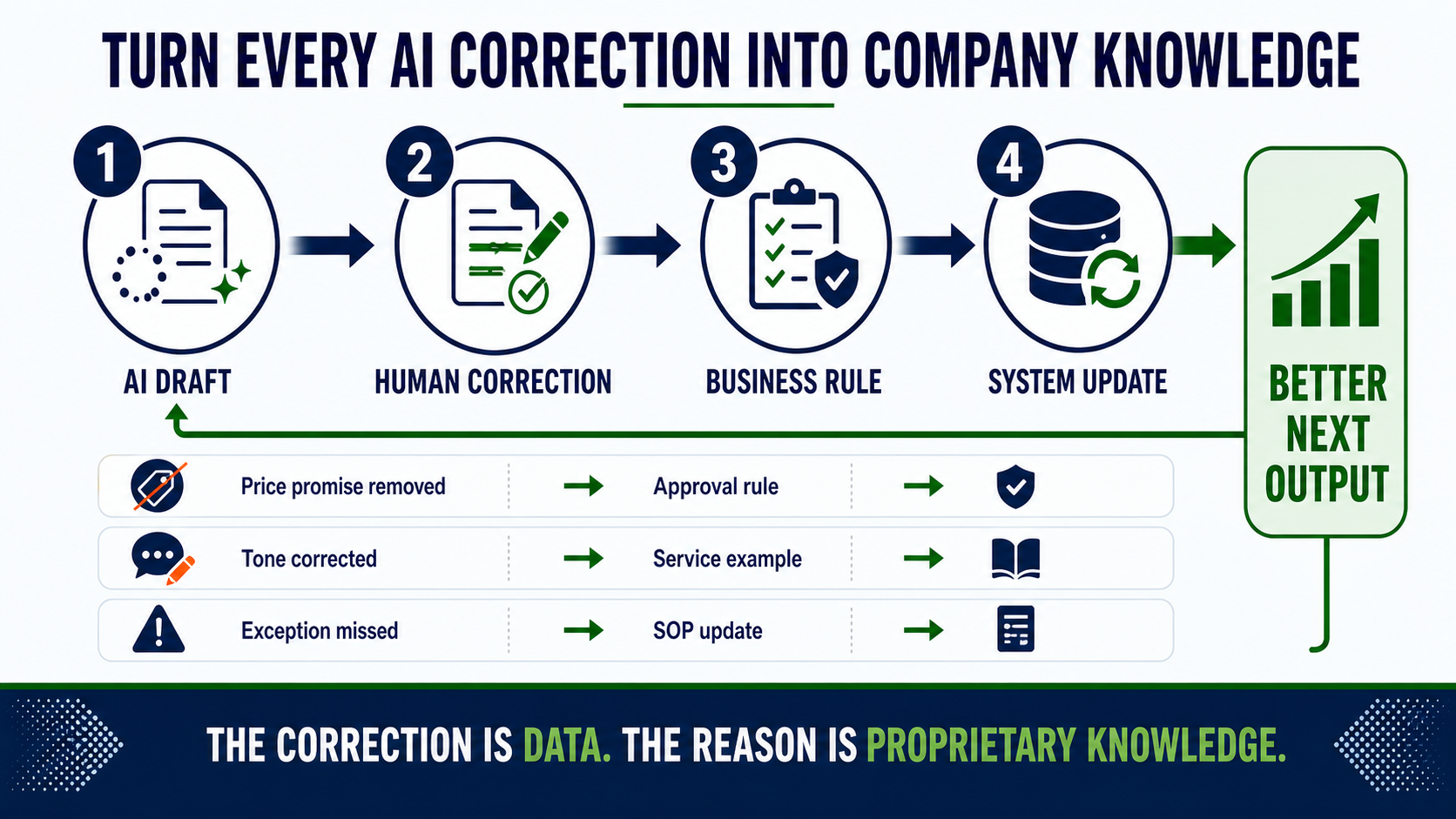
The corrected sentence saves one document. The reason for the correction can improve every future document.

Click the image above to learn about Bob’s Trusted Adviser program for SMBs that want to scale.
For a free business assessment Zoom call on what is holding your company back that you may not see, click here. Bob Norton does all these personally. This offer is for CEOs and owners of companies with at least $500K in revenue or six or more employees. A complete written report is available to anyone for $1,200.